
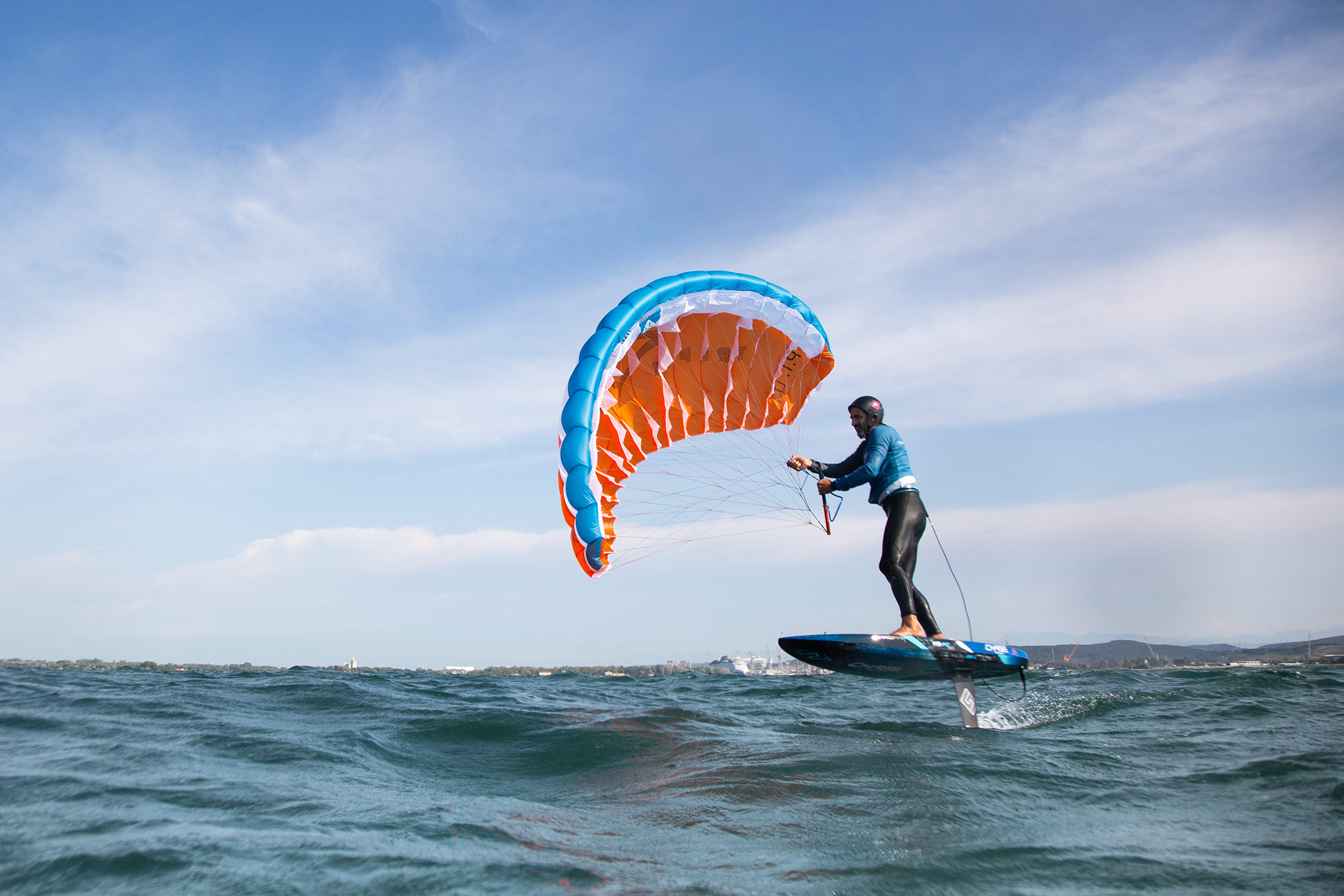
When a new parawing enters the market, first impressions are easy to find. What interests us much more is what happens after hundreds of miles on the water.
Bryan Lee from Wouzel has now published an exceptionally detailed independent review of the Triple Seven P.T. LTX, based primarily on more than 200 miles of riding with the 3.1 m, additional testing of the 2.4 m, and conditions ranging from approximately 15 to 45 knots.
And his conclusion certainly caught our attention:
“The 3.1m LTX is my favorite parawing to date.”
For us, the interesting part isn’t simply the conclusion. It is why he reached it.
A parawing designed around usable range
One of Bryan’s strongest observations concerns the LTX’s top-end wind range and depower.
The P.T. LTX uses approximately 25% double-surface construction, combining some of the stability and aerodynamic characteristics of a double-surface parawing with the simplicity and compactness riders expect from a highly stowable design.
During testing, Bryan rode the LTX 3.1 m from 15–38 knots without finding its upper limit, while his 2.4 m saw conditions reaching 45 knots.
He particularly highlights how composed the LTX remains when the wind increases and agrees with our own 10/10 top-end rating.
That wide usable range can mean something very practical on the water: fewer situations where you suddenly feel massively overpowered and potentially fewer sail changes when conditions become gusty.
Depower that changes how the parawing can be used
Perhaps even more interesting is Bryan’s description of the LTX’s depower.
Rather than seeing the parawing simply as something that needs to be deployed for the upwind leg and immediately packed away for the downwind, he found himself using the LTX differently.
The ability to quickly dump power, combined with the short lines, allowed him to position himself on swell, depower and transition rapidly into surfing.
This became one of the defining characteristics of his experience with the LTX.
In his words, the LTX started to challenge the idea that “you must pack it away immediately.”
That is very close to what we wanted from the LTX concept: a parawing that becomes less intrusive during the entire session and gives the rider more freedom to decide when to fly, retract, surf or redeploy.
Retract, stow and redeploy: 10/10
One of the biggest surprises in Bryan’s review was something riders may not initially consider the most exciting performance metric: retraction.
It became one of his favourite characteristics of the LTX.
The combination of strong depower and very short lines allows the LTX to retract rapidly, while the canopy naturally comes together into a compact concertina.
Bryan reports minimal tangling, quick packing and easy management even in strong wind.
While we rate the LTX 9/10 for stowing and 9/10 for redeployment, Bryan went one step further:
Stow: 10/10
Redeploy: 10/10
After hundreds of miles, he describes missed redeployments as being very rare.
For riders who frequently transition between powered riding and free foiling, that reliability can ultimately be more important than a performance number on a specification sheet.
Short lines with a purpose
The LTX’s short line concept is immediately noticeable.
Shorter lines make the entire system more compact, but they also play an important role during transitions. Less line needs to be managed during retraction and redeployment, helping make the complete process faster.
Bryan initially wondered whether the lines might actually be too short.
After extensive time on the water, his conclusion was the opposite: they became an important part of the way he now rides.
Combined with the LTX’s depower, the result encouraged him to make more frequent transitions between flying and surfing rather than treating deployment and stowing as major events during a run.
The harness loop becomes an unexpected favourite
Another detail Bryan singles out is the integrated two-point harness loop.
Its positioning allows the rider to trim the LTX while hooked in and, importantly, to move into a strongly depowered position when conditions increase.
After several hundred miles, Bryan describes this system as something he now considers essential to his riding.
It is a relatively small design element, but exactly the kind of detail that becomes noticeable only after spending serious time with a product.
Not designed to hide its compromises
We have always tried to describe the LTX for what it is rather than claim that one parawing can dominate every performance category.
The LTX is not our low-end specialist.
We rate its low-end performance at 6/10, and Bryan’s testing largely confirms this. Getting onto foil at the very bottom of the wind range requires the right conditions and technique.
Once flying, however, he found its ability to carry through lighter sections significantly better than its initial take-off power might suggest.
This distinction is important.
Parawing design is always a balance between low-end power, upwind performance, stability, depower, handling, stowability, redeployment and usable wind range.
With the LTX, we deliberately placed particular emphasis on range, top-end control, compactness and fast transitions between flying and surfing.
A different way to look at parawing performance
One of our favourite parts of Bryan’s review is his observation about where parawing development may be heading.
Early development focused heavily on upwind ability. Then attention increasingly moved toward low-end power.
Bryan argues that the next major performance characteristic is range.
We tend to agree.
A wide usable range isn’t simply about surviving stronger wind. It allows riders to choose smaller foils and boards, handle gusty conditions with greater confidence and potentially stay with the same parawing as conditions change.
Combined with easy depower, fast retraction and reliable redeployment, it can also change the rhythm of an entire session.
And that is perhaps the most important conclusion from this review.
The P.T. LTX didn’t simply perform well for Bryan. It changed the way he wanted to use a parawing.
Read the complete independent P.T. LTX review
Bryan’s article goes considerably deeper than we can cover here, including his equipment setup, wind ranges, comparisons with other parawings, thoughts about different LTX sizes, construction details and several hundred miles of real-world experience.
We strongly recommend reading the complete review:
Read Bryan Lee’s full 777 LTX Parawing Review on Wouzel
You can also discover the design, technical details, sizes and wind ranges of the Triple Seven P.T. LTX.
For us, independent reviews like this are particularly valuable because products ultimately have to prove themselves where they were designed to be used: on the water, session after session.